Why Google Ads Amplifies Chaos When a Website Is Not Ready

Updated: Jul 19

This article explains why Google Ads often underperforms when a website is not ready. Based on real pre-ads visibility testing across different B2B companies, it shows how unclear positioning, mixed intent signals, and homepage misalignment lead to low-quality demand. The examples demonstrate why visibility and readiness should be assessed before launching advertising, not after.
Table of Contents
Introduction
Before launching Google Ads, I always run a series of tests and a visibility review.
Not to delay advertising, but to understand what advertising will actually amplify.
Across very different projects and industries, I consistently observe the same issue: a clear mismatch between the client a business wants and the signals its website sends, already visible on the homepage.
Below are two anonymised examples from real visibility audits: a beauty salon and an international travel agency.
Different industries. Different services. The same structural problems.
What “chaos before advertising” looks like
Chaos is not about poor design or missing content.
It appears when a website fails to communicate three critical things clearly:
who the business is for
what problem it actually solves
how a qualified client should recognise themselves
When these signals are unclear or contradictory, Google Ads does not fix the situation. It simply scales existing ambiguity.
More traffic does not mean better demand.
Real patterns observed during pre-ads visibility testing
Example 1: Industrial equipment supplier (B2B) Observed during visibility testing
The business supplied specialised testing and measurement equipment to industrial clients. Sales involved procurement teams, technical evaluators, and long buying cycles.
However, the homepage showed:
product-catalog language without industry or application context
no distinction between end-user and distribution channels
no signals defining the decision-maker or qualifying criteria for enquiries
Visibility impact
For search engines, ad systems, and AI classifiers, this resulted in:
unclear positioning between supplier and retailer signals
mixed search intent (procurement vs. consumer queries)
difficulty identifying the professional buyer profile
As a result, advertising would attract volume-based clicks, not qualified procurement interest. Google Ads would amplify ambiguity about who the business actually serves.
Example 2: Engineering consulting firm (B2B) Observed during visibility testing
The company provided process engineering consulting for manufacturing and energy-sector clients. Projects involved multiple stakeholders and decision cycles of several months.
However, the website:
resembled a standard professional services template without industry specificity
did not explain what a "qualified project" looked like from the buyer's perspective
lacked signals differentiating strategic consulting from general technical support
Visibility impact
Without these signals, Google Ads would:
attract early-stage research queries from unqualified visitors
fail to differentiate between project-ready buyers and exploratory traffic
reduce the relevance of incoming enquiries for business development teams
In this state, advertising increased visibility without improving the quality of demand.
The recurring pattern across audits
In both cases, the same issue appeared:
The desired client existed in the business strategy, but not clearly on the website.
If a homepage does not consistently signal:
target audience
positioning and differentiation
decision-making context
then neither search engines nor AI systems can interpret the business correctly.
Advertising in this state scales noise, not understanding.
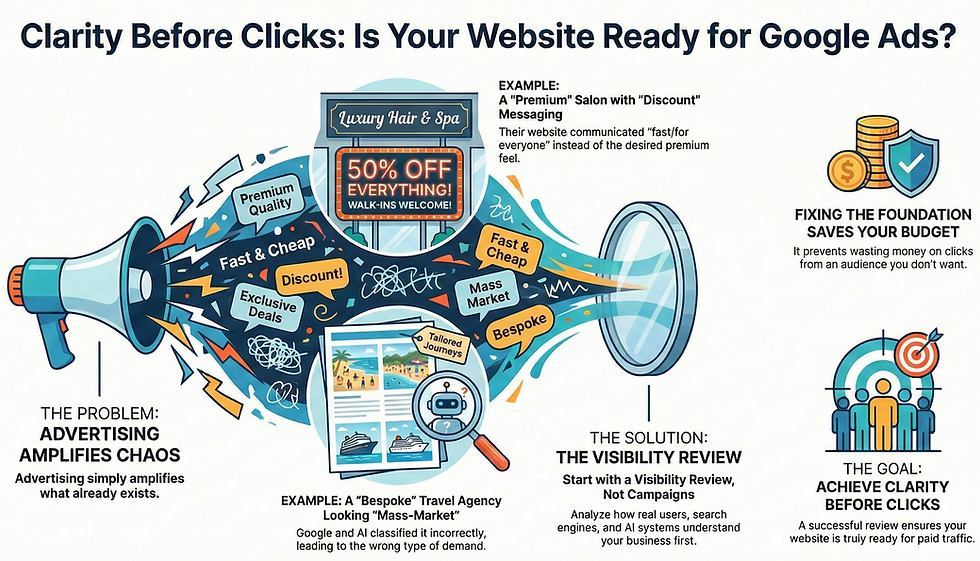
Why I start with a visibility review, not campaigns
Before running or scaling Google Ads, I assess:
how real users interpret the website
how search engines classify it
how AI systems understand intent and relevance
This visibility review helps determine:
whether advertising should start now
what must change before launch
how to avoid inefficient spend and misaligned demand
Sometimes this leads to launching campaigns. Sometimes it leads to intentionally postponing advertising until clarity is restored. Both outcomes are valid and measurable.
When Google Ads works as intended
Google Ads performs best when:
positioning is explicit
homepage signals match the desired client
advertising amplifies existing clarity instead of compensating for it
Visibility is therefore not an optimisation step after launch. It is a precondition for effective advertising and AI discoverability.
Key takeaways
Google Ads amplifies existing website signals
unclear positioning leads to low-quality demand
visibility testing identifies misalignment before budget is spent
clarity benefits users, search engines, and AI systems alike
For the specific structural adjustments that stabilise these signals, see 10 Structural Adjustments That Stabilise Google Ads Performance in Industrial B2B.
Frequently Asked Questions
Why does Google Ads fail even with good targeting?
Because advertising amplifies the signals already present on the website. If positioning, intent, or audience signals are unclear, Google Ads increases traffic not relevance.
What is website readiness for Google Ads?
Website readiness means that the homepage clearly communicates:
who the business is for
what problem it solves
what a qualified enquiry looks like
This clarity allows search engines, ad systems, and AI tools to interpret the business correctly.
Is visibility the same as SEO?
No. Visibility includes how a business is understood by:
real users
search engines
AI systems
SEO is one component of visibility, but not the whole picture.
Why test visibility before launching ads?
Testing visibility before advertising helps:
avoid low-quality leads
prevent wasted ad spend
decide whether ads should be launched now or postponed
This turns Google Ads into a decision-driven channel, not an experiment.
Can Google Ads work without a visibility review?
Sometimes, but results are unpredictable. Without visibility testing, advertising often compensates for unclear positioning instead of scaling demand.
Final note
A visibility review is not about optimisation.
It is about making informed decisions before investing in advertising.
For more on structural readiness before advertising, see the free book in the Library →


Comments